

From 2 kW to 1.8 MW: High-Power Testing with the ITECH IT8100A/E Series
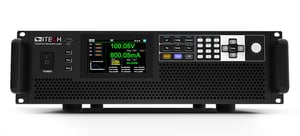
Higher power is only part of the challenge. Modern power systems are becoming more dynamic, more complex and increasingly difficult to reproduce under controlled test conditions.
AI server power supplies, DC charging infrastructure, power modules and fuel cells are just some examples where engineers need to validate how a system behaves under demanding and changing load conditions.
The ITECH IT8100A/E Series Ultra-Dynamic High-Power DC Electronic Load is designed for exactly this environment – combining scalable high-power testing with dynamic load capabilities and flexible functions for application-specific validation.
From 2 kW to 1.8 MW
One of the defining characteristics of the IT8100A/E Series is its scalability.
The series covers a power range from 2 kW up to 1.8 MW and is available with voltage ranges of:
60 V | 150 V | 600 V | 1200 V
This broad range allows test systems to be configured around the actual requirements of the device under test – from individual power components and power supplies to significantly larger high-power systems.
For development and validation teams, this scalability becomes particularly valuable when test requirements change or when different power classes need to be covered within the same test environment.
But power capability alone does not tell the whole story.
From 2 kW to 1.8 MW is only part of the story
Modern power systems rarely operate under perfectly constant conditions.
Loads can change rapidly. Operating profiles can vary significantly. And the behaviour engineers need to investigate may be much more complex than simply switching between two static current levels.
This is particularly relevant for applications such as AI server power supplies, where changing computing workloads can result in highly dynamic power demands.
The important question is therefore no longer only:
How much power can the electronic load handle?
It is also:
Can the test system reproduce the load behaviour the application will actually experience?
This is where the ultra-dynamic capabilities of the IT8100A/E become particularly relevant.
Reproduce dynamic load conditions
The IT8100A/E Series is designed for high-speed dynamic load testing, allowing engineers to create changing load conditions and investigate how a device under test responds.
Instead of validating a power system only under steady-state conditions, dynamic testing can provide a more detailed picture of its behaviour when the load changes.
For engineers developing power supplies and other high-power electronics, this can help investigate questions such as:
How does the DUT respond when demand suddenly increases?
How stable is the output during changing load conditions?
And how does the system behave when the load profile becomes more complex?
These questions are becoming increasingly important as power density and system performance continue to increase.
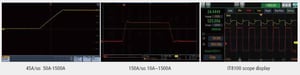
Real load behaviour. Repeatable in the lab.
Not every real-world load can be adequately represented by predefined test steps.
The IT8100A/E Series therefore supports user-defined waveforms, enabling engineers to create application-specific load profiles and reproduce them under controlled test conditions.
This adds an important dimension to validation.
Rather than relying exclusively on standardised load sequences, engineers can use customised waveforms to simulate behaviour that is closer to the conditions their products may encounter in the actual application.
A complex load profile can therefore become a controlled and repeatable laboratory test.
This is particularly useful when investigating transient behaviour, validating design changes or repeatedly testing a device against the same demanding load profile.

A closer look at AI server power testing
AI infrastructure provides a good example of why dynamic load testing is becoming increasingly relevant.
High-performance processors and GPUs can create rapidly changing demands on the surrounding power architecture as computational workloads change.
For the power supply, this means that maximum output power is only one aspect of performance. Engineers also need to understand how the system responds when demand changes.
An ultra-dynamic electronic load provides a controlled way to reproduce these conditions during development and validation.
This allows engineering teams to move beyond simple maximum-load testing and investigate the dynamic behaviour of the power system.
More than power supply testing
The IT8100A/E platform is designed for a broad range of high-power applications.
Typical applications include:
- AI server power supplies
- DC charging piles
- Power modules
- Fuel cells
- Battery-related testing
- High-power electronic systems
The combination of multiple voltage classes, scalable power and dynamic loading capabilities means that the same platform concept can address very different validation requirements.
Battery discharge testing
The IT8100A/E Series also provides dedicated functionality for battery discharge testing.
This allows batteries and related energy-storage systems to be evaluated under controlled discharge conditions.
For engineers working with battery systems, this extends the electronic load beyond conventional power-supply validation and makes it possible to investigate discharge behaviour within the same test environment.
Combined with programmable test conditions, this can support repeatable evaluation across different operating scenarios.
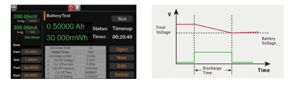
See what happens during the test
Generating the correct load profile is one part of the test. Understanding what happens during that test is another.
The IT8100A/E therefore integrates a graphical touchscreen interface designed to provide direct access to operating parameters and test information.
Different visualisation functions help engineers observe measurements and waveform behaviour directly on the instrument.
This can make it easier to configure tests, analyse behaviour and identify relevant events without relying exclusively on an external control environment.
For automated setups, the series can also be integrated into larger test systems through its available communication interfaces.
One platform for changing requirements
High-power test environments are rarely static.
A system developed for one project may later need to accommodate a different voltage level, a higher power class or a completely different application.
This is where the broad architecture of the IT8100A/E Series becomes particularly interesting.
With power configurations ranging from 2 kW to 1.8 MW and voltage options of 60 V, 150 V, 600 V and 1200 V, engineers can select a configuration according to the actual requirements of the application.
The result is not simply a high-power electronic load.
It is a platform designed to support scalable, dynamic and application-specific DC load testing.
Is your test environment ready for the next power level?
As AI infrastructure, electrification and high-power electronics continue to evolve, validation environments need to evolve with them.
More power alone is not enough.
Engineers increasingly need to reproduce dynamic, application-specific load behaviour while maintaining controlled and repeatable test conditions.
The ITECH IT8100A/E Series brings these requirements together in one scalable electronic-load platform – from 2 kW up to 1.8 MW.
Because the key question is no longer simply:
How much power can you test?
It is:
Can you reproduce what your application will actually experience?
Computer Controls can support you in selecting the appropriate ITECH IT8100A/E configuration for your voltage, power and application requirements.